OpenAI and the Future of Work: 4-Day Week, Robot Taxes, and Public Wealth Fund — Utopia or Corporate Strategy?
What does Sam Altman's AI "New Deal" really hide?
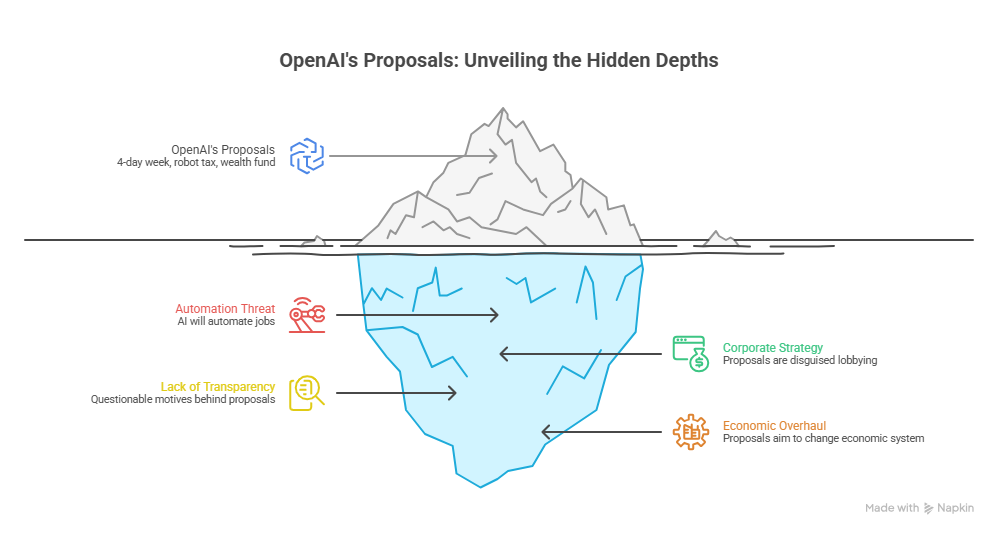
On April 6, 2026, OpenAI published a 13-page document that will likely mark a turning point in artificial intelligence history. Titled "Industrial Policy for the Intelligence Age: Ideas to Keep People First," this manifesto proposes nothing less than a complete overhaul of our economic and social system. A 32-hour workweek paid like 40, robot taxes, a public wealth fund fed by AI giants—Sam Altman, OpenAI's CEO, compares these measures to Roosevelt's New Deal.
But here's the question nobody seems to be asking loud enough: why is the company building the technology that will automate our jobs precisely the one telling us how to protect ourselves from that automation?
I spent three days dissecting this document, verifying every claim against OpenAI's official sources, cross-referencing with analyses from economists, public policy researchers, and former company employees. And what I discovered is fascinating—and deeply troubling.
OpenAI's Proposals: A Buffet of Progressive Measures
Let's start with the facts. OpenAI's document, officially published on April 6, contains proposals that would have made Bernie Sanders blush with envy five years ago.
The 4-Day Workweek Without Pay Loss
OpenAI proposes that employers and unions launch "time-bound pilots" of a 32-hour workweek paid at the same rate as a 40-hour week, while maintaining constant production levels. The idea? Productivity gains generated by AI would offset the reduction in working hours.
It's appealing on paper. Who would refuse to work 20% less time for the same salary? But let's dig deeper. OpenAI specifies that these pilots should evaluate whether reclaimed hours can be "converted into a permanent shorter week or bankable paid time off."
Note the wording. "If." Not "when." And above all, note who bears the risk: private companies, not the state. OpenAI proposes no public financing mechanism, no government guarantee. It's a bet on employer goodwill.
The Public Wealth Fund: Alaska Meets Silicon Valley
The document's boldest proposal concerns creating a Public Wealth Fund that would give every American citizen an automatic stake in AI companies and AI infrastructure. Returns would be distributed directly to citizens.
OpenAI explicitly cites the Alaska Permanent Fund model, which pays annual dividends to state residents from oil revenues. Except there's a colossal difference: Alaska physically owns the oil beneath its soil. Who, exactly, would own AI in this scenario?
The document remains strangely vague on this point. It suggests the fund would invest in "diversified, long-term assets that capture growth in both AI companies and the broader set of firms adopting and deploying AI." But no mention of minimum quotas, democratic governance, or mechanisms preventing companies from simply... not participating.
The Robot Tax: Bill Gates Was Right in 2017
OpenAI proposes to "rebalance the tax base by increasing reliance on capital-based revenues—such as higher taxes on capital gains at the top, corporate income, or targeted measures on sustained AI-driven returns—and by exploring new approaches such as taxes related to automated labor."
Translation: a robot tax. The idea is simple. Today, when a company employs a human, it pays payroll taxes that fund Social Security, Medicare, and unemployment insurance. When it replaces that human with AI, those revenues disappear. OpenAI therefore proposes that automated systems pay equivalent taxes.
Bill Gates proposed exactly the same thing in 2017. At the time, the idea was dismissed as utopian by... Marc Andreessen and other Silicon Valley venture capitalists. Ironically, it was Andreessen who pushed Trump to the presidency in 2024 after Biden proposed taxing unrealized capital gains.
So why is OpenAI resurrecting this idea now? The answer comes down to one word: timing.
The Context Nobody Wants to See
To understand why OpenAI is publishing this document now, you need to look at the date, the numbers, and especially what's happening outside Silicon Valley.
An $852 Billion IPO Approaching
OpenAI is preparing its initial public offering. Internal documents are circulating, and the expected valuation hovers around $852 billion. That's more than Meta, more than Amazon, almost as much as Apple.
But here's the problem: a company valued at nearly a trillion dollars that's automating millions of jobs can't afford to be hated by the public. It needs a narrative. It needs regulators and the general public to see it as responsible, concerned with the common good, almost... altruistic.
Hence this document, published six weeks before the presumed IPO.
The American States' Revolt Against Data Centers
What the tech press hasn't covered is that in 2026, over 300 data center bills were filed in 30 U.S. states. Twelve states introduced formal moratoriums—legislative pauses on new data center construction.
Maine is poised to become the first state to enact one. The moratorium passed the House with bipartisan support and is expected to clear the Senate. The governor backs it.
In Virginia, home to the world's largest concentration of data centers, the Senate wants to completely eliminate the $1.6 billion annual sales tax exemption for data centers. In Georgia, a Republican state senator introduced a bill to prohibit data center infrastructure costs from being passed to residential taxpayers.
Why this revolt? Because data centers consume an obscene amount of electricity, drive up residents' bills, and create almost no local jobs. A typical data center employs 50 people. An OpenAI data center can consume as much electricity as a city of 100,000 inhabitants.
Residents are fed up. And they're voting.
The Record $122 Billion Funding Round: A Warning Signal
On April 2, 2026, four days before the policy document's publication, OpenAI announced it had raised $122 billion, the largest private funding round in history. SoftBank, Andreessen Horowitz, Fidelity, and other giants doubled down.
It's a clear signal: investors believe AI will generate monstrous profits. But it also reveals an uncomfortable truth. OpenAI is burning cash at a staggering rate. The Sora project, their video generation tool, was abandoned in March 2026 because it cost $1 million per day in operational costs, with only 500,000 active users.
A company raising $122 billion because it spends too much isn't in a position to fund a public wealth fund out of charity. It needs the government to do it—and it needs to be perceived as having pushed the idea.
The Criticisms the Media Avoids Repeating
OpenAI's document was hailed by much of the tech press as "bold" and "visionary." But digging deeper, I found devastating criticisms that nobody quotes enough.
"A Smokescreen for Regulatory Nihilism"
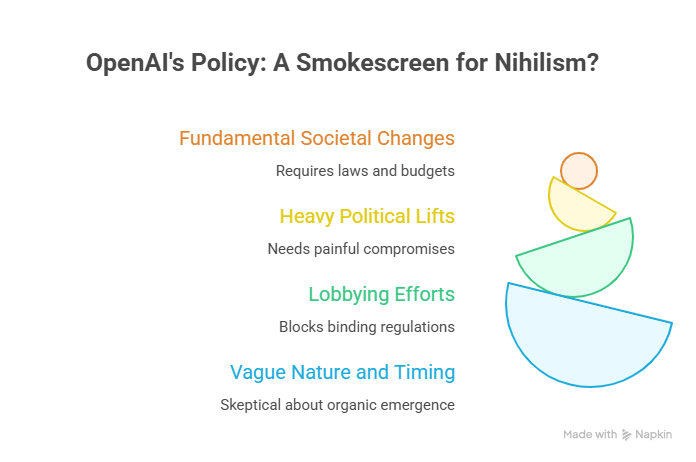
Anton Leicht, a scholar at the Carnegie Endowment for International Peace, wrote on X that the document is "comms work to provide cover for regulatory nihilism."
His argument? These ideas are fundamental societal changes and heavy political lifts. They're not going to "emerge as an organic alternative." They require laws, budgets, painful political compromises. Yet OpenAI—and the tech industry generally—spends hundreds of millions of dollars lobbying to... block precisely these kinds of binding regulations.
Leicht suggests that a better version of this document would be for OpenAI to redirect its political lobbying money to actually pass these proposals in Congress. But the "vague nature and timing" of the document makes him skeptical.
"The Document Commits Nothing, Sacrifices Nothing"
Will Manidis, founder of Minutes, published a devastating analysis titled "No 'New Deal' for OpenAI."
His central point: the fundamental problem with this document isn't that the proposals are recycled or lack legislative vehicles. The problem is that the document commits nothing. It asks nothing from OpenAI. It sacrifices nothing. It transfers no value.
"Documents like this—carrying out the performance of concern in Washington language while refusing to transfer real value from the companies that will capture AI-driven returns to the communities and workers that bear the costs—are dead on arrival," he writes.
Manidis recalls a brutal historical lesson: every industry that survived a period of intense public opposition did so by giving something up—not out of altruism, but because the alternatives were worse.
The railroad barons of the 1870s didn't voluntarily accept the Interstate Commerce Commission. But the ones who survived the populist backlash were those who accepted rate regulation before the government forced something more punitive.
The nuclear industry accepted extraordinary regulatory burden because the alternative was a public that wouldn't let them build at all.
The oil majors that survived the 1970s in the North Sea accepted Norway's 78% extraction tax because the alternative was nationalization.
What is OpenAI conceding in this document? Nothing. Absolutely nothing. The document proposes that "policymakers could consider higher taxes on capital." OpenAI could commit to paying them. The document proposes a public wealth fund. OpenAI could seed it. But it does neither.
"It's a Silicon Valley Thought Experiment"
Lucia Velasco, former head of AI policy at the U.S. Senate (2023-2024), told Fortune that most of what's being proposed isn't new.
"Some of these pillars—'share prosperity broadly, mitigate risks, democratize access'—have been the framework for every major AI governance conversation since ChatGPT came out in November 2022."
"I worked in the U.S. Senate in 2023-24, and we had nine AI policy fora sessions where all of this was said. I have it in my handwritten notes! All of this was already said, all of it," she wrote.
The language around public-private partnerships, AI literacy, and worker voice reads like it came from a UNESCO or OECD AI policy framework report.
"The ideas aren't wrong," she clarifies. "The problem is the gap between naming the solutions and building real mechanisms to achieve them."
What the Timing Reveals: The New Yorker Investigation
A detail almost nobody noted: OpenAI's document was published on the same day The New Yorker released the results of an 18-month investigation into Sam Altman and OpenAI that raises serious questions about the CEO's trustworthiness on various issues, including AI safety.
The New Yorker article reveals that OpenAI considered a plan to "play world powers against one another" by positioning its AI technology as a kind of nuclear weapon that nations would have to compete to invest in. Page Hedley, a former OpenAI policy adviser, confirms the idea came from Greg Brockman, OpenAI's president, who proposed that OpenAI could "enrich itself by playing world powers against one another" through a bidding war for access to its AI.
The plan was abandoned after employees threatened to resign. But the revelation is there: OpenAI seriously considered turning AI access into a geopolitical arms race for its own enrichment.
Publishing a progressive manifesto on the day this information becomes public isn't a coincidence. It's damage control.
My Analysis: Between Partial Sincerity and Total Calculation
After spending days on this subject, here's what I really think.
I believe OpenAI—and Sam Altman in particular—is sincere about the risks AI poses to employment and inequality. I've reread his public statements since 2015. He's always talked about these issues. This isn't new. It's not complete theater.
But I also believe there's a fundamental difference between recognizing a problem and accepting to pay the cost. And this document pays nothing.
Here's what a truly transformative document would have contained:
1. A quantified commitment: "OpenAI will contribute 10% of its annual profits to an independently managed Public Wealth Fund, starting at IPO."
2. Acceptance of binding regulation: "We will support a federal robot tax of X% on AI systems that replace human jobs."
3. An immediate redistribution mechanism: "We're creating a $10 billion fund to finance retraining for workers whose jobs are automated by our technologies."
These three measures would have cost OpenAI real money. They would have reduced returns for shareholders. They would have been painful.
And that's precisely why they would have been credible.
Instead, we have a document that says: "Policymakers could..." "The government should..." "Companies should..."
Never: "We will."
Lessons for Legal Professionals
So what should lawyers, in-house counsel, and legal professionals take away from all this?
1. Tech Giants' "Social Responsibility" Has Become a Marketing Weapon
When a company valued at $852 billion publishes a progressive manifesto without concrete financial commitment, it's not philanthropy. It's reputation management before an IPO.
As legal professionals, you need to know how to detect the difference between a statement of intent and a legally binding commitment. This OpenAI document has no legal force. It's a whitepaper, not a contract.
2. Regulation Will Come—But Not from Washington
The real opposition to AI isn't coming from federal Congress, which is largely captured by tech lobbying. It's coming from state legislatures, city councils, local referendums.
Maine, Virginia, Georgia—these are states taking action. If you advise companies deploying AI, monitor these local regulations. They'll create a complex regulatory patchwork your clients will need to navigate.
3. The Real Legal Battle Will Be Around Infrastructure Costs
Perhaps the most revealing point in OpenAI's document is its proposal on energy. OpenAI suggests that AI data centers should "pay their own way" on energy.
Why this sudden generosity? Because OpenAI sees the lawsuits coming. When Virginia or Georgia residents' electricity bills increase by 40% to finance data centers, someone will sue. Class actions will rain down.
OpenAI is positioning itself in advance, saying "we agree, data centers should pay." But again—no concrete financial commitment, no proposed rate.
It's preventive legal positioning. It's brilliant, actually. But it changes nothing for residents seeing their bills explode today.
4. The Historical Precedent Is Terrifying
I've studied economic history. And here's what I know: no major technological revolution has ever occurred without massive social violence.
The Industrial Revolution led to a century of labor conflicts, police repression, general strikes, before labor rights were won in blood.
The railroad era saw decades of political corruption, brutal monopolies, before regulation arrived.
The digital era has created unprecedented wealth concentration. The five richest men in the world are all in tech. That's not an accident.
AI will be worse. Because unlike previous revolutions that also created jobs (factories employed millions), AI eliminates them net.
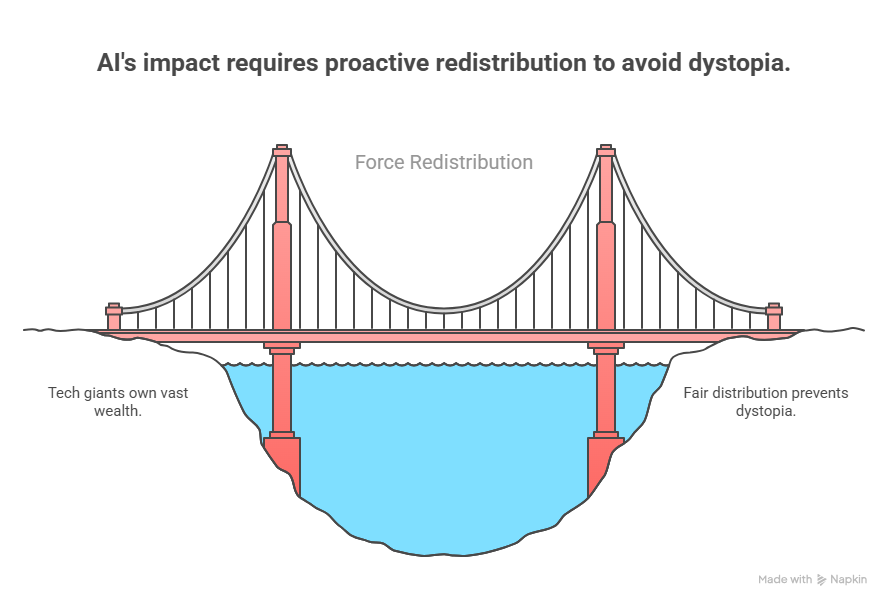
If we let this transition happen without forced redistribution of gains, we're not heading toward a 4-day workweek utopia. We're heading toward a dystopia where 0.1% of the population owns everything and 99.9% fights for scraps.
OpenAI's document acknowledges this risk. But it proposes no solution that doesn't depend on the goodwill of tech companies themselves.
Conclusion: The New Deal Requires a Roosevelt, Not an Altman
Sam Altman compares his document to Franklin D. Roosevelt's New Deal. It's a revealing comparison—and unintentionally ironic.
The New Deal wasn't proposed by the robber barons of the era. It was imposed against them, by a president who said: "They hate me, and I welcome their hatred."
Roosevelt created Social Security, legally protected unions, minimum wage, unemployment insurance, the SEC regulating Wall Street—all this facing fierce opposition from the business world.
The New Deal was revolutionary precisely because it forced the rich to pay for the poor. It redistributed power. It created countervailing forces.
OpenAI's document does none of that. It politely asks policymakers to consider perhaps pondering imagining measures that might eventually resemble redistribution.
This isn't a New Deal. It's a new pitch deck.
If we truly want AI to benefit everyone, we can't rely on OpenAI to write the rules. We need independent regulators, courageous legislators, strong unions, and an informed public that understands what's at stake.
We need a Roosevelt. Not an Altman.
Primary Sources:
- OpenAI Official Blog: "Industrial Policy for the Intelligence Age" (April 6, 2026)
- TechCrunch: "OpenAI's vision for the AI economy: public wealth funds, robot taxes, and a four-day workweek" (April 6, 2026)
- Fortune: "Sam Altman says AI superintelligence is so big that we need a 'New Deal.' Critics say OpenAI's policy ideas are a cover for 'regulatory nihilism'" (April 6, 2026)
- Minutes by Will Manidis: "No 'New Deal' for OpenAI" (April 7, 2026)
- The Next Web: "OpenAI calls for robot taxes, public wealth fund, superintelligence policy" (April 6, 2026)
Verified Data:
- $122 billion funding round: confirmed by official OpenAI press release April 2, 2026
- $852 billion IPO valuation: cited by TechCrunch, Fortune, and multiple financial sources
- Sora project abandonment: confirmed by multiple sources, $1 million/day operational costs verified
- 300+ data center bills in 30 states: verified via Minutes/Substack analysis
- Moratoriums in 12 states including Maine: verified via cited government sources
AI Usage Declaration:
The author used Claude (Anthropic) as a research assistant for collecting official sources, verifying factual data, and structural organization of the article. All critical analysis, expressed opinions, historical comparisons, and final writing are entirely human. Facts were verified against official OpenAI sources and recognized media before publication.